1) How do you promote your films/works?
This is often the most difficult part of the process. The way I see it, today, you have three avenues:
1) Try to collaborate with somebody who already has a following on social media, or similar connections (i.e. a music video for a musician).
2) Take advantage of film festivals and similar community events where folks with similar interests gather.
3) Meet and get to know folks who are better versed in marketing than you are—folks who have worked in film marketing will be particularly helpful, but I would also encourage you to learn as much as possible about marketing in general from anybody you can. Many marketing principles and lessons crossover from different industries. Many filmmakers, including myself, can tend to focus so intensely on their art that it can be very difficult to have the energy left to promote it after you cross the finish line in the editing room. Promotion really comes down to relationships, exposure and/or money. Believe it or not, there are a lot of people with a lot of money, even in this current terrible economy, who are ready and very willing to be a part of something creative that is beyond their individual artistic capacity. Many people really do appreciate art who are otherwise pretty terrible at making it on their own, haha. These folks often become the benefactors of the arts (whether by simply buying tickets to shows or even by directly funding projects as executive producers). The real trick is getting connected with them. It’s as the old saying goes, “it’s all in who you know”.
For example, the distance running documentary that I am currently working on is going to be promoted through my brother’s former agent who represented him when he was a professional distance runner at Nike. This fellow happens to have done a ton of work in film production on similar historical running films over the past decade. We are hoping to sell our documentary to Netflix. We will see how it goes 🙂
2) What do you do to be confident in your ability when it comes to film?
Wow, really great question…
In short, watch and study film with a passion! When push comes to shove, you will at least know that you know what you are talking about, while other folks, who haven’t studied film history, will not. Moreover, you will have an easier time developing a vision for a film, as well as getting other folks on board with that vision, if you have more points of reference for what effective visual storytelling has looked like throughout the decades. In general, the goal of such a passionate study should not be to inflate your own ego, but rather to give you an extremely developed sense of “what cinema is” as an art form. If you devote yourself to this, a good deal of confidence and inspiration will naturally follow.
I encourage you to start at the very beginning…I’m talking early 1900s silent short films:
Voyage to the Moon (1902) – https://www.youtube.com/watch?v=kanrWwkeG0E
Here is another early silent short on YouTube (one of my favorites):
Alice in Wonderland (1915) – https://www.youtube.com/watch?v=pRNCYvnt4N4&t=16s
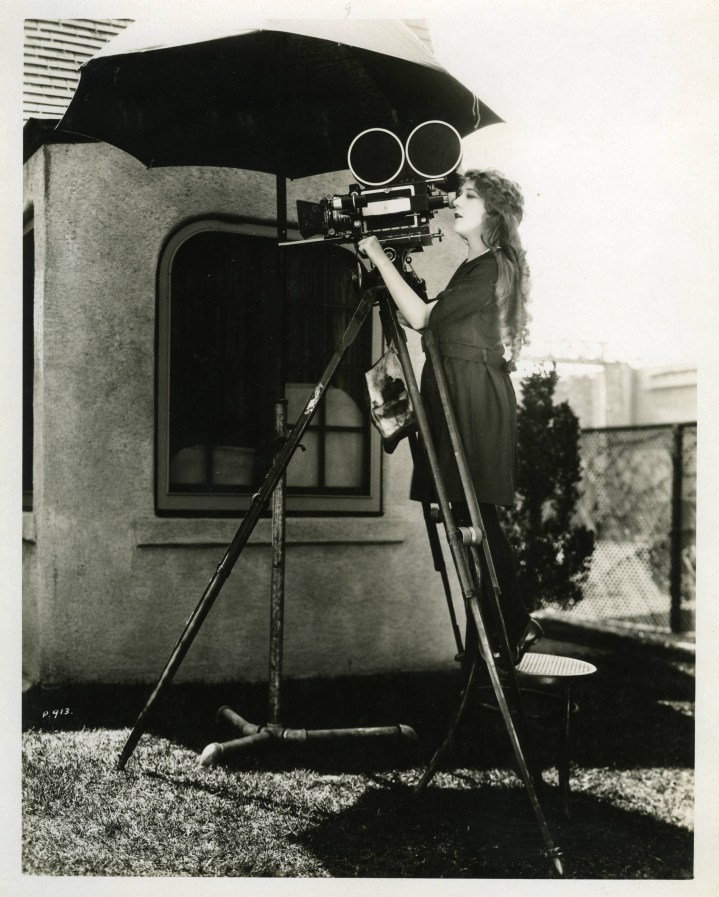
I also highly recommend silent feature-length films by Mary Pickford (“The Love Light” 1921 is my fav), Charlie Chaplin, Harold Lloyd, Buster Keaton, and Fritz Lang’s silent era work, especially “Metropolis” (1927).
Start getting a grasp on what motion picture storytelling has looked like in every decade. It is a very young art form in that it has only been around 110-120 years.
Study what kinds of cameras, lenses, lighting techniques, film stocks, image sensors, etc were used to make your favorite films. Become a geek for the details. I cannot stress this enough. For a visual medium, I cannot believe how many people I have met throughout the years who claim to be interested in filmmaking but essentially have no interest in figuring out what tools were used to create their favorite films. That would be like saying you want to be a painter but never caring enough to learn the difference between oil and acrylic paints. IMDB and Wikipedia are great resources for this kind of information.
Try to know a little bit about every single step in the process of what makes a film beautiful. Dig dig dig, and while you are figuring out all of those details, copy, copy, copy… or rather, emulate, emulate, emulate…
This is an old adage, often misconstrued in the USA where we have a funny averseness to emulating the art of others. Particularly in filmmaking. This averseness is not shared by other film-obsessed places like France or Japan, for example, where many filmmakers consider even outright plagiarism as “the highest form of flattery”. Now, obviously, I am not advocating for outright plagiarism, but we must not be afraid to do what all of the best painters and musicians have done throughout the years—that is, learn how to paint or play like all of the best artists who came before you, before you throw out the rulebook and try to craft your own style.
Also, it is important to remember that even if you make a short film in the style of a particular director, for example, that it is still YOU making the film, with your brain, your heart, and your creative mind, and therefore it will never be exactly like the original.
If you “copy“ as a mechanism of learning, eventually, your “copying“ will evolve into your own creation—that is, assuming that you actually have a conviction to create art that is independent of ONLY a desire for money or fame. There’s nothing inherently wrong with money or fame, but if you desire those things before creating good art, then said “copying” will never develop you as an artist, rather it will only serve to inflate your ego and likely cause you to make things that look ‘exactly like what everyone else is doing’. The only way for your film to stand out from the crowd is to first make sure you become your own person, with your own individual palette of inspirations and interests. If you ever feel isolated in this, like that nobody else gets you or what you are into, good…that means you are becoming your own artist, and more importantly, your own person. It can be lonely sometimes but I promise that you will eventually find and actually attract folks who resonate with the things you are into and the art you are making—sometimes for nothing else than the fact that they see that these things are authentically yours.
In the art world today, there are essentially two attitudes: One is, “its all been done before” (cynical, why do these people even make art…ugh) and the second is, “it’s all been done before… so let’s do it again!” It obviously has not all been done before, but even if it had, so what? Does beauty grow old and tired? Are we not made for beauty? To have a constant relationship with it, to surround ourselves with it and continue to be moved by it? To reshape, reorganize, and recreate it? I think so. A lot of artists often “claim” to not care about anything, waxing nihilism, but I usually don’t buy it. There is no reason to make film, or art of any kind, if you are not moved by beauty in some fundamental capacity—even if it were unbeknownst to you at the time. Now you will meet some folks who “don’t care that much”—who primarily view filmmaking as “a job”, and that is fine, but you will rarely find folks at the top of the artistic food chain, as in a director or cinematographer, who have such a perspective. It takes too much sacrifice to get to that place to not care immensely about what beauty you are creating. Actors can be a little different, but that’s another story.
A final important note on how to stay inspired and confident is simply to find out what the inspirations have been for your favorite filmmakers. Many of the best directors over the past century have written books, given countless interviews, and detailed their inspirations from childhood to adulthood. Read what they read, watch what they watched, listen to the music they listened to. Figure out what makes/made these artists tick, what convicted them to want to tell stories in a visual capacity. A great resource for this kind of thing is The Criterion Collection, which releases films on BluRay and 4K discs that have accompanying books full of essays by film scholars oftentimes writings by the directors themselves.
Stay inspired. Stay curious. Always be learning and growing. And the confidence will come.
3) Do you get nervous working with others with different mindsets?
Yes! Admittedly, I often don’t like to work with others, at least in a way that feels like it “constricts” my creativity, haha, but you HAVE to force yourself to do it. After all, no man is a island…aka, we live in a very communal world. And filmmaking is one of, if not the most, communal art forms…just sit through the credits and count names next time you are at the theater. Having said that, dealing with people gets easier as you grow and learn about different people’s personalities, motivations, passions, and desires—note: figuring out your own, first, is usually square one in figuring out those of others. Stay humble, even if you know you have a better idea, there is rarely an occasion where listening cannot teach you something, so long as you are patient—even if it is just learning about another facet of human psychology that you can incorporate into a character in your next film 🙂
On a more scientific note, if you have any access at any point to personality tests such as StrengthFinders, Predictive Index, Big Five, EQI, or the like, these can be extremely helpful tools in assembling a proper team where everybody has a job that suits their strengths or specific skill set (some of these are free and some are available to schools and the like). Oftentimes, conflict with another artist or negative energy on set can be mitigated or reshaped for the betterment of the project by a solid designation of what each person’s role is. Though “a role” may feel confining for folks at first, it can often be the very thing that sets them free to focus on one thing and do it really well. If you really want to make films, as in the role of a director, then knowing a little bit about each job on set will take you a very long way toward working well with others. If you can speak a little bit of the technical language of the cinematographer, the editors, the actors, the gaffers, etc, this will not only make for better working relationships with people, it will literally make your films better. Communication is key—don’t be afraid to give people direct examples of what you want too. Years ago, I was (maybe subconsciously) too proud to send a still image from one of my favorite films to my colorist as reference for how I wanted a music video colored…it wasted quite a bit of time and money, haha.
4) If you ever get doubtful about your job, what motivates you?
Hmm…wow…been there. Many times. Doubtful that is…about my art, my job, etc.
It may sound hyperbolic, but you have to ask yourself “what do I live for?” You know, “what are the really big things that actually matter?” Because at the end of the day, those are the things that all timeless works of art are about. All good art is ultimately about the big questions and the big important stuff. From Spongebob to Mozart to Francis Ford Coppola, the common thread is moving and identifying with people on a deep level—be it on the plane of laughter and silliness (yes, these are deep emotions), melody and harmony, or phenomenal lighting and cinematography. All of these things, just by existing, and stimulating our senses, beg similar foundational questions about the good, the bad, and the ugly of the human experience.
Even the aforementioned art that is expressly “meant to be meaningless” by the artist almost always ends up ironically meaning something to someone, inspiring something good, even if that is simply identifying with a common human question or emotion (i.e. emptiness, loss, or the like). Now don’t get me wrong, there is bad art to boot (see SolarSands on YouTube, haha), and there are things that people call art, that are definitely more like advertising or political propaganda than art. But nevertheless, even a spoof of art often subtly asks deeply philosophical questions about art, and thereby, becomes art, sometimes very “high art”, in its own right. Side Note: not that I care much about them these days, but I will never understand why, for this reason, comedy is not a category at the Academy Awards. I actually think comedy is harder to do, at least to do VERY well, than almost all other art forms.
What continues to motivate me personally is how I see God’s love and purpose in every experience of beauty from the smallest spring flower to the most jaw-dropping mountaintop vista. Every breathtaking moment beckons me to deeper purpose and reason. And when I find myself in places where I feel like I have no answers to big questions, I never cease to find solace in art and nature. Be it a walk in the park with my wife, a Lord of the Rings marathon with friends, or a foreign film that I watch by myself in my basement…it all comes back to beauty. And wherever you find beauty–true, timeless beauty–inspiration and motivation are not far behind, even if just to share an experience you’ve had (be it a film, a record, or a sunset on Powell Butte) with a friend.
Anyway, hope this helps!
Thank you for your patience. I’m very sorry if I held you up from getting your project in on time.
Sincerely,
-Alec Eagon
 Alec Eagon - Blog